


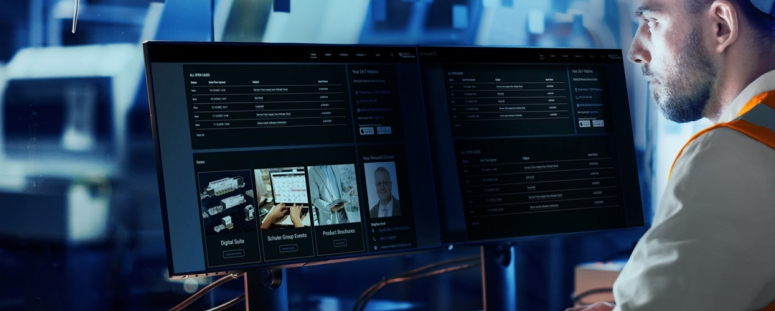
With the staggering advances in the field of Artificial Intelligence (AI) in recent years, the vision of the Autonomous Factory is moving a significant step closer. The interfaces required to connect individual systems within a production complex, as well as to the outside world, are already in place. By deploying AI, existing capabilities can be considerably expanded, allowing diverse manufacturing processes to be interconnected in highly efficient ways.
The Autonomous Factory
Despite various new impulses, the fundamental goals associated with the implementation of the Autonomous Factory remain unchanged. It is still a matter of combining high quality with maximum cost-efficiency to produce as competitively as possible. In this context, new ways to increase the efficiency of manufacturing processes continue to be sought—either by increasing output or reducing production overhead—increasingly extending beyond the factory walls.
The Human Factor
Transformation is currently occurring at an accelerated pace. The guiding principle is "Hands off": the operator's function is limited solely to monitoring production processes. The use of intelligent software for targeted monitoring moves autonomy another essential step forward. Systems are thus enabled to detect and precisely indicate problems independently ("Eyes off") and are ultimately further developed to the point where they can rectify identified errors themselves ("Mind off"). Humans can determine for themselves the point up to which the system can and should resolve each problem independently.
Intelligent Networking
The impact that the optimal connection of interfaces has on Overall Equipment Effectiveness (OEE) is substantial. They incorporate a range of parameters whose data is recorded and processed within the manufacturing process. In the case of metalworking machines, this includes precise details regarding the raw materials supplied (such as composition, thickness, width, surface finish), the assignment of serial numbers (e.g., via laser marking), and other process parameters concerning the system itself (such as laser power, gas pressure, or cutting speed), right through to recording information regarding warehouse management and shipping. Especially in the manufacturing sector, the data gathered here and its intelligent networking can significantly accelerate the processing cycle and reduce potential time losses.
The areas in which corresponding advantages can be achieved through the intelligent networking of production can be defined as follows:
-
Increased Output In press shops, increasing the stroke rate by just a few strokes per minute can result in high percentage performance gains. Simulation or setup tools such as DigiSim or Smart Assist from ANDRITZ Schuler help to realize potential increases in stroke rates. Process stability can be further enhanced through the use of camera monitoring systems.
-
Optimization of Availability In addition to direct performance increases, improving availability is one of the key levers for optimizing OEE. Besides the (automatic) recording and evaluation of downtime, connected processes such as coil and die changes, as well as additional information provided by the operator, should also be included.
-
Reduction of Scrap To minimize production scrap largely automatically, the corresponding influencing variables must be identified and located, and their potential causes eliminated. Automated, camera-based quality inspection—both inline and offline—can provide valuable support, as can tools that record process deviations or fluctuations.
-
Enhanced Sustainability In combination with predictive resource planning and optimal material utilization, sustainable measures can also reduce costs. Tools such as the Energy Monitor from ANDRITZ Schuler record energy requirements during production, providing the data basis for the EU-introduced Digital Product Passport (DPP) as proof of a company's own circular economy practices.
-
Conclusion
Simultaneously, a paradigm shift in data analysis has been observed in recent years. Development is moving from user-generated data evaluation to real-time evaluation ("Agentic AI") and finally to the full integration of AI-supported systems. If one follows the vision of an Autonomous Factory to its logical conclusion against this backdrop, the result is an even more intensive partnership between suppliers and customers. New platforms will not only serve buyers and sellers for exchange within core business activities but will also create entirely new opportunities for collaboration that we cannot even imagine today.
Contenu


