


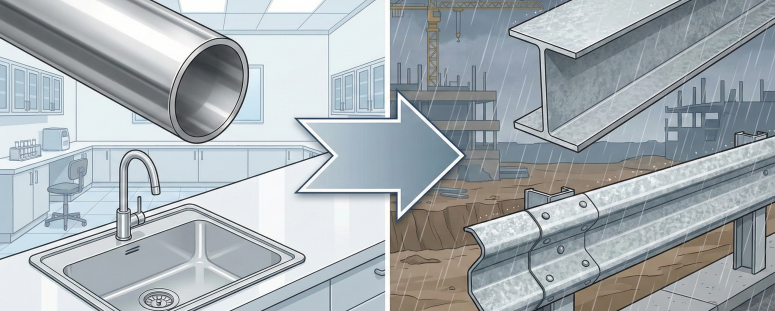
In the field of sheet metal working and metal construction, the choice of material is a crucial step that determines the longevity, strength, and final cost of a part. Faced with the risk of corrosion, two solutions often stand out to design offices and buyers: stainless steel and galvanized steel. Although both are designed to resist rust, their manufacturing processes, properties, and costs differ significantly. So, how do you make the right choice for your industrial projects? This detailed comparison helps you decide.
What is stainless steel (Inox)?
Stainless steel is not a steel that has undergone a surface treatment, but an alloy. It is composed of steel (iron and carbon) to which a minimum of 10.5% chromium is added. It is this chromium that, upon contact with oxygen, creates an invisible chromium oxide layer, called the "passive layer". If the surface is scratched, this layer reforms instantly, thus protecting the metal from corrosion throughout its mass.
-
Advantages: Exceptional corrosion resistance (especially for 316L grades in marine or chemical environments), an almost unlimited lifespan, excellent resistance to extreme temperatures, and a high-end aesthetic.
-
Limitations: Cost. Stainless steel is significantly more expensive to purchase and more complex to machine or weld (requiring specific gases like Argon).
-
What is galvanized steel?
Unlike stainless steel, galvanized steel is a standard steel (carbon steel) that has been coated with a protective layer of zinc to prevent rust. The most common and effective process is hot-dip galvanizing: the steel part is immersed in a bath of molten zinc (at around 450°C / 842°F). The zinc bonds metallurgically to the steel, forming a sacrificial barrier.
-
Advantages: An excellent quality/price ratio. The protection is very robust against impacts (zinc oxidizes instead of steel in the event of a scratch). It is the preferred material for outdoor structures (frameworks, guardrails, street furniture).
-
Limitations: If the zinc layer is deeply damaged over the decades, the steel will eventually rust. The aesthetic is more raw (matte gray or spangled appearance) and welding galvanized steel releases toxic fumes, requiring the area to be welded to be ground beforehand.
-
Selection criteria: Which one to choose for your project?
-
Operating environment: This is the #1 criterion. If your part is intended for a highly corrosive environment (chemical industry, food processing, saline/marine environment), stainless steel (especially 316L) is imperative. For standard outdoor use exposed to rain, galvanized steel will do perfectly for decades.
-
Budget: If the budget is tight, galvanized steel is the clear winner. Stainless steel can cost up to three or four times more depending on raw material prices and the chosen grades.
-
Aesthetics and hygiene: Stainless steel offers a shiny, brushed, or mirror finish that is highly prized in design, interior architecture, or the medical and food sectors (for its hygienic properties). Galvanized steel retains a very industrial look.
-
Conclusion
The choice between stainless steel and galvanized steel is not just a question of "quality", but of suitability for the need. Favor galvanized steel for large outdoor structures where robustness and price are decisive. Opt for stainless steel when the environment requires it, or for sanitary and aesthetic reasons. In all cases, a good value analysis upstream of the sheet metal design is essential.
Contenu


